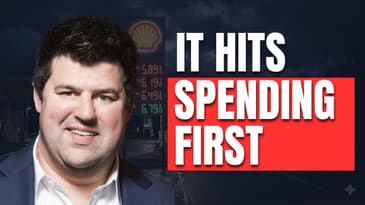
Bob also breaks down how to think about global macro investing today, including why traditional portfolios may be poorly positioned for a wider range of outcomes, how macro managers are adapting to shifting conditions, and how AI-driven productivity gains could impact economic growth, labor, and markets.
Bob Elliott on Twitter
[https://twitter.com/BobEUnlimited](https://twitter.com/BobEUnlimited)
Unlimited Funds website
[https://www.unlimitedfunds.com](https://www.unlimitedfunds.com)
Topics covered
* The shift from an income-driven economy to a savings-driven economy and why it creates fragility
* Why an oil shock acts as both an inflation driver and a tax on real consumer spending
* How higher gas prices mechanically reduce discretionary spending and economic growth
* Why markets may be underpricing the economic impact of the current oil shock
* The link between oil prices, inflation expectations, and real demand destruction
* How global markets respond to shocks through deleveraging and volatility spikes
* Why gold and other winning trades can fall during risk-off environments
* The sequencing of inflation first and growth slowdown later in shock-driven cycles
* How central banks are likely to respond to a stagflationary shock
* Lessons from 2022 and 2008 for understanding today’s macro environment
* Why stocks and bonds may both be mispriced in the current regime
* The difference between consumer surplus and true productivity gains from AI
* Why AI-driven job losses and economic growth cannot coexist without major dissaving
* The most likely path for AI as a productivity enhancer rather than a job destroyer
* How to think about measuring productivity in a technology-driven economy
* The role of second- and third-order effects in macro investing
* How global macro strategies identify mispricings across asset classes
* The concept of using the “wisdom of the crowd” from hedge fund positioning
* Why macro strategies can perform in both rising and falling markets
* How macro fits into a portfolio as a diversifier versus long-only assets
* Why the future investment environment may require broader strategy diversification
Timestamps
00:00 Oil shock meets a savings-driven economy
01:00 Framing the macro environment: oil, inflation, and growth
02:12 What a savings-driven economy means for market fragility
04:46 Why household income vs spending divergence matters
07:00 First principles of an oil shock and demand inelasticity
08:00 How oil price spikes flow through to inflation
10:00 Real spending power and the consumer impact of gas prices
11:00 Savings vs retrenchment: how households respond to shocks
13:00 Global market reactions and emerging market dynamics
14:00 Deleveraging and volatility driving asset price reversals
15:44 Why gold declines during macro stress events
17:17 Institutional positioning and ETF flows in gold
17:34 Inflation first, growth slowdown later: sequencing the impact
19:24 Is the economic damage already done
22:00 How macro investors operate in low-conviction environments
24:00 Cross-asset mispricings and what markets are missing
26:42 Second- and third-order effects in macro investing
27:00 What central banks do in an oil-driven inflation shock
29:19 What the Fed should do versus what it will do
31:00 Comparing today’s environment to 2022 inflation dynamics
33:00 Why markets are pricing in almost nothing
34:00 AI and the link between labor, income, and spending
37:11 Productivity vs consumer surplus in AI adoption
40:00 Why better tools don’t necessarily mean higher productivity
41:00 Micro example of AI’s impact on business economics
43:25 The “world of abundance” debate and economic constraints
46:00 How global macro strategies are constructed
48:00 Using hedge fund positioning as a signal
50:00 Transparency, liquidity, and ETF advantages
51:00 What has driven recent macro strategy performance
54:00 Where macro fits in a diversified portfolio
56:00 Why the opportunity set for macro may be expanding