
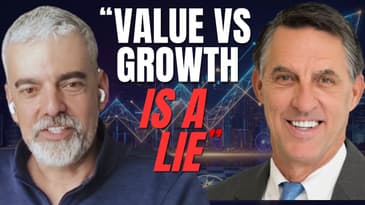
Topics covered in this episode
* Why value investing has nothing to do with price to earnings or price to book ratios
* The false divide between value and growth investing and why growth is a component of value
* How abstractions and labels distort decision making in markets
* General semantics and how language shapes investing mistakes
* Charlie Munger’s concept of worldly wisdom and the latticework of mental models
* Why reversion to the mean is a flawed way to think about markets
* The stock market as a complex adaptive system rather than a predictable machine
* Why most market forecasts fail and why people still believe them
* Myopic loss aversion and how frequent evaluation destroys long-term returns
* The importance of time horizon, patience, and long-term compounding
* How great investors think about conviction, uncertainty, and being wrong
* When to hold through difficulty versus when to exit an investment
* Lessons from Buffett, Munger, and Bill Miller on thinking independently
Timestamps
00:00 Value investing beyond ratios and labels
01:00 Introducing Robert Hagstrom and Chris Mayer
02:30 Investing as a subdivision of worldly wisdom
04:10 Abstractions, language, and Wall Street thinking
07:30 General semantics and investing mistakes
09:00 Latticework of mental models and interdisciplinary thinking
12:30 Buffett’s rejection of Wall Street jargon
18:55 Value versus growth and why the labels fail
23:40 Language, meaning, and investment errors
27:00 Time horizon, myopic loss aversion, and frequent evaluation
31:00 Sideways markets and where returns really come from
36:50 Complex adaptive systems and why prediction fails
40:00 Spurious correlations and false cause and effect
45:00 Forecasting, randomness, and the illusion of certainty
48:00 Conviction, expectations, and uncertainty in investing
50:00 When to sell and the cost of being wrong
54:30 Building an interdisciplinary investing framework